
What is SEO in Digital Marketing? Understanding the Basics in 2026.
Have you ever spent five minutes searching for a specific cosmetic brand or maybe looking for a new shirt or shoe, only to close your browser and move on with your day.
Then, an hour later, you open Instagram and there is an ad for that exact product. You switch over to YouTube to watch a video, and the pre-roll ad is a glowing review of the same brand.
It feels like a coincidence, or maybe like your phone is reading your mind. But in reality, it’s something much more strategic. It’s the digital world’s way of keeping a conversation going after you’ve left the room. This invisible thread that connects your search to your social feed is the heartbeat of modern business.
What is SEO in Digital Marketing?
If the internet is a massive library with billions of books, SEO (Search Engine Optimization) is the process of making sure your book is the one the librarian recommends first.
It is a branch of digital marketing focused on increasing your website’s visibility in the ‘organic’ (non-paid) search results. In 2026, this isn’t just about ranking on a page, it’s about being the most relevant answer to a user’s specific problem.
In short, SEO is a two-way bridge:
For Search Engines: It helps bots read and trust your website.
For Users: It ensures they find high-quality content that actually solves their needs.
When you do SEO well, you aren’t chasing customers, they are finding you.
How Google Makes Money? (And Why it Matters for You)
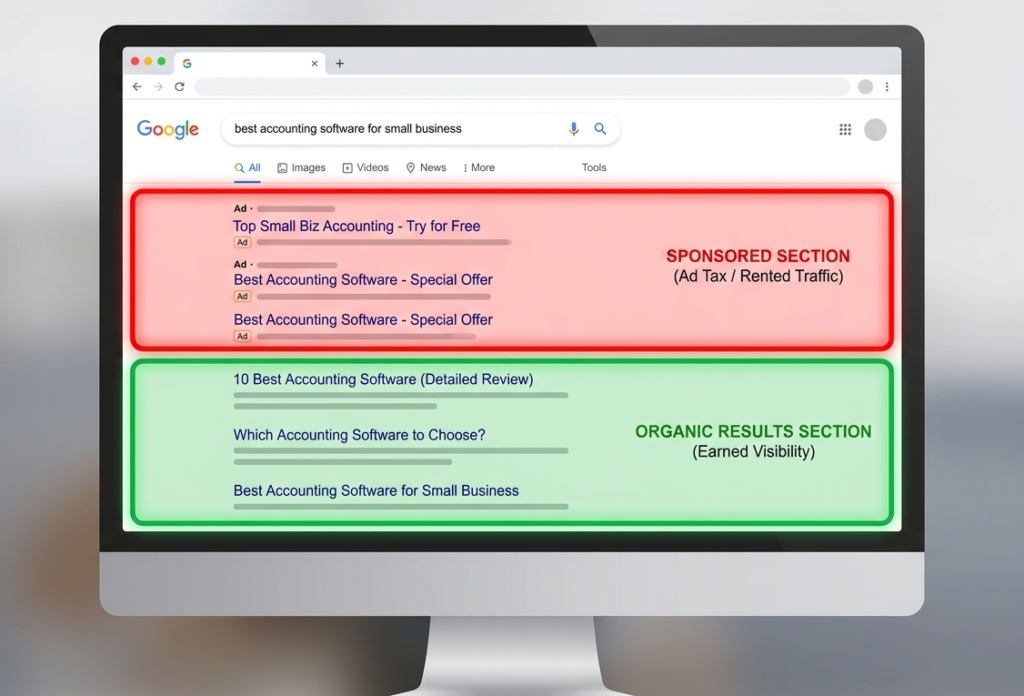
To master SEO, you have to understand that Google is not a non-profit library, it is one of the world’s largest advertising companies.
The majority of Google’s revenue comes from Google Ads. When you search for something, the top few results are usually ‘Sponsored.’ Companies pay Google every single time someone clicks on those links.
Why this matters for your SEO strategy:
The ‘Ad Tax’: If you rely only on ads, you are paying a permanent tax to stay visible.
The Trust Gap: Many users instinctively skip the ads and scroll down to the organic results. Organic results have more trust among users because they know those spots weren’t bought, they were earned.
Google wants to keep users happy so they keep coming back to see more ads. To do that, they must show the best free content underneath the ads.
By focusing on SEO, you are providing the high quality content Google needs to keep its users happy. In return, Google gives you prime real estate on the front page for free.
What is the Objective of SEO?
Many people believe the only goal of SEO is to Rank #1 on Google. While that is a great milestone, the true objective is much deeper than a number.
The primary goals of a solid SEO strategy are:
Building Trust: Users trust Google. If Google puts you on the first page, that trust transfers to your brand.
Quality Traffic: It’s not about getting everyone to your site; it’s about getting the right people who are actively looking for what you offer.
Long Term Consistency: Unlike a social media post that disappears in 24 hours, an optimized blog or page can bring you customers for years.
Improving User Experience: SEO forces you to make your site faster, cleaner, and easier to navigate. What’s good for Google is almost always good for your customer.
Ultimately, the objective of SEO is to turn your website into your most hard working salesperson who never sleeps and doesn’t charge a commission.
How SEO Works: Moving from ‘Renting’ to ‘Owning’.
In digital marketing, you have two choices: you can rent your audience or you can own your presence.
Renting Traffic (Paid Ads):
Think of this like staying in a hotel. You pay for the space, and it’s great while you’re there. But the second you stop paying, you have to pack your bags and leave. You have zero equity in that space.
Owning Traffic (SEO):
SEO is like buying a house. It requires a down payment of time and effort. You have to maintain it and build it up. However, over time, the mortgage is paid off. You own that spot on the first page, and the traffic it generates is yours to keep without a daily bill.
The Shift in 2026:
The goal of modern SEO is to build a Digital Asset. When you own your traffic:
-
- Your marketing costs go down.
-
- Your brand value goes up.
-
- You are no longer at the mercy of fluctuating ad prices.
By moving from a renter to an owner, you aren’t just getting clicks you are building a sustainable business.
The 3 Pillars: On-Page, Off-Page, and Technical SEO
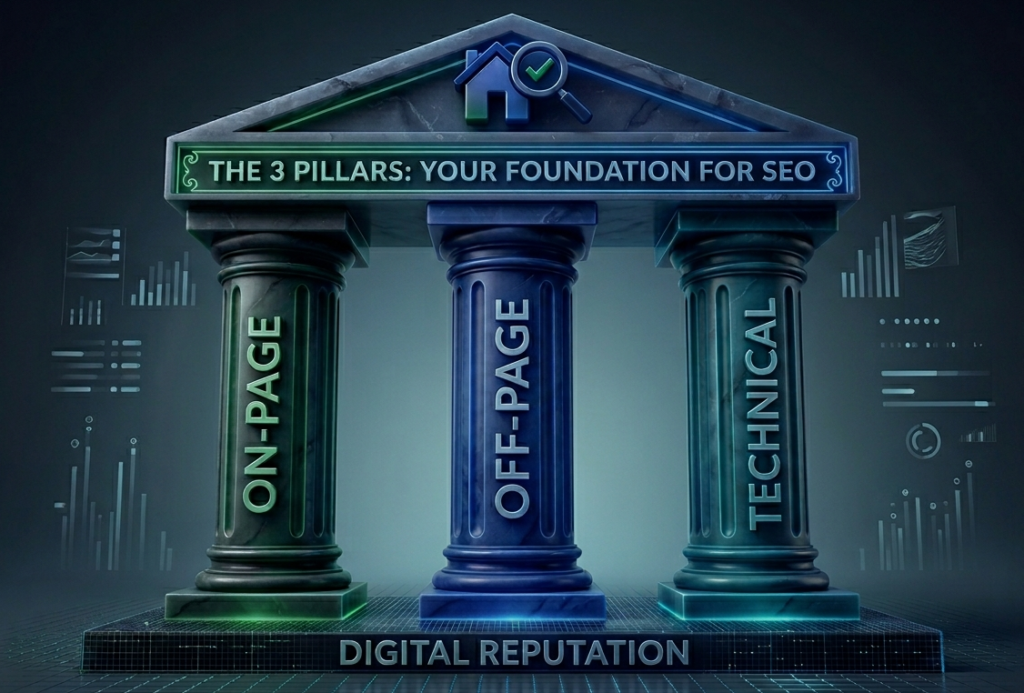
To rank well in 2026, your website needs a balance of three specific areas. Think of it like building a home that people actually want to visit.
1. On Page SEO (The Interior Design)
This is everything people see on your website. It’s about making your content helpful and relevant.
Keywords: Using the right terms your customers are searching for.
Quality Content: Answering questions clearly and honestly.
Headings & Images: Organizing your page so it’s easy to read.
2. Off Page SEO (The Neighbourhood Reputation)
This is about your website’s relationship with the rest of the internet. Google wants to see that other people trust you.
Backlinks: When other reputable websites link to yours.
Social Signals: People sharing and talking about your content.
Authority: Proving you are an expert in your field.
3. Technical SEO (The Foundation & Plumbing)
This happens behind the scenes. If the foundation is cracked, it doesn’t matter how pretty the house is.
Site Speed: Does the page load instantly?
Mobile-Friendliness: Does it look great on a phone?
Security: Is your site safe for visitors (HTTPS)?
SEO vs. Paid Ads: Why Your ROI is Leaking
Many businesses pour money into paid ads (PPC) while ignoring SEO, but this often leads to a ‘leaky bucket’ problem. If your website isn’t optimized, you are paying for clicks that won’t turn into customers.
Why SEO is the fix for your ROI:
The Bounce Factor: You can pay $5 for a click, but if your site is slow or the content is confusing (Technical & On-Page SEO), that user will leave immediately. You just lost $5.
Cost Per Acquisition: Over time, the cost of ads usually goes up as competition increases. SEO does the opposite, it lowers your average cost per lead as your organic traffic grows.
Consistency vs. Spikes: Ads give you a spike in traffic that disappears when the budget runs out. SEO provides a steady stream of visitors that keeps your ROI stable.
The Bottom Line: Paid ads are great for short-term growth, but SEO is what ensures your marketing budget isn’t being wasted on a site that isn’t ready to convert.
Understanding Search Intent: Why Keywords Are Only Half the Battle
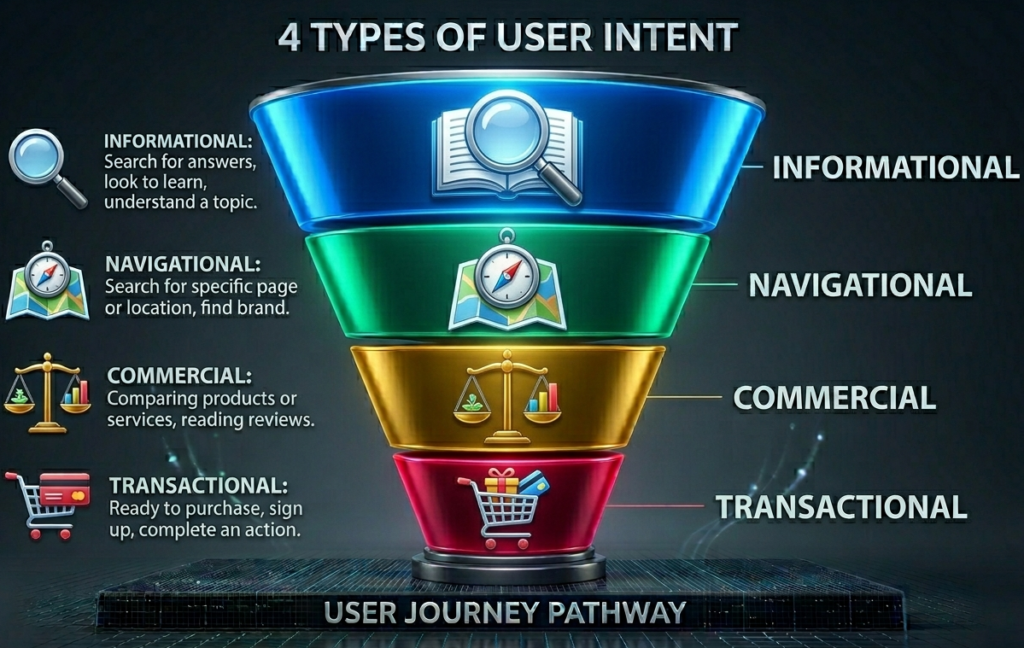
Years ago, you could rank on Google just by repeating a keyword over and over. Today, Google is much smarter. It looks for Search Intent, the specific reason behind a user’s search.
If you don’t match the intent, you won’t rank, no matter how many times you use the keyword.
There are 4 main types of Intent:
Informational: The user wants to learn something. (e.g. “What is SEO?”)
Navigational: The user is looking for a specific website. (e.g.”Google Search Console login”)
Commercial: The user is researching options before buying. (e.g.”Best SEO tools for small business”)
Transactional: The user is ready to buy right now. (e.g. “Buy SEO audit”)
Why this matters:
If someone searches for a ‘Simple Guide’ (Informational) and you send them to a ‘Buy Now’ sales page (Transactional), they will leave immediately. To win at SEO, your content must provide the exact type of help the user is looking for at that moment.
Why Being Found Online is the Ultimate Advantage
In the modern market, the best company doesn’t always win, the most visible one does. If your competitor is on the first page of Google and you are on the second, they are essentially invisible to 90% of your potential customers.
SEO gives you an edge because:
It’s Active, Not Passive: Unlike a billboard or a TV ad that interrupts someone’s day, SEO catches people at the exact moment they are looking for a solution.
Leveling the Playing Field: A small business with a well-optimized website can outrank a billion dollar corporation. On Google, quality of information matters more than the size of your bank account.
24/7 Presence: Your website doesn’t have business hours. SEO ensures that even while you are sleeping, your brand is being discovered by new leads.
Being found online isn’t just nice to have, it is the difference between being a leader in your industry or being a secret.
SEO in 2026: Navigating AI and the Future of Search
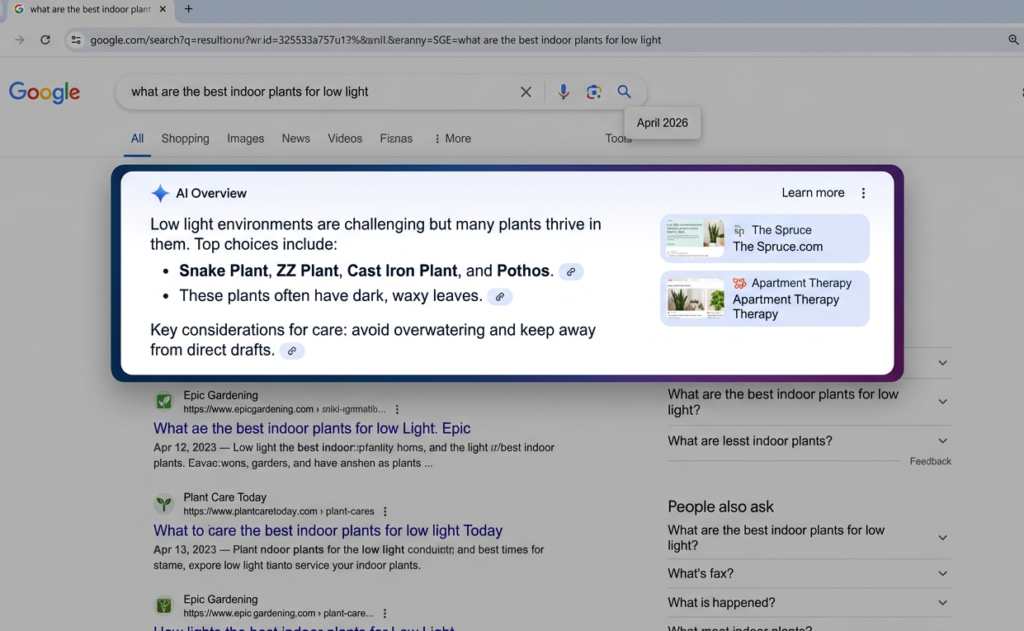
The biggest shift in 2026 is the integration of Artificial Intelligence into how we search. You’ve likely seen AI summaries (like Google’s AI Overviews) appearing at the very top of your results.
Many people fear this means SEO is dying. In reality, it’s just evolving.
How Search is Changing:
-
- From Keywords to Conversations: People are now asking full questions (e.g. “How do I fix a leaky pipe in a top floor flat?”) rather than typing short phrases.
-
- The Rise of SGE (Search Generative Experience): Google uses AI to summarize the best content from across the web. To be featured in that summary, your content needs to be incredibly clear and accurate.
-
- E-E-A-T is King: Google prioritizes Experience, Expertise, Authoritativeness, and Trustworthiness. AI can generate text, but it cannot experience things. Showing your real world expertise is now your greatest SEO superpower.
The Future is Human Centric: Search engines are becoming more human. The best way to navigate the future of search isn’t to chase the latest AI trend, it’s to focus on being the most honest, relatable, and helpful source of information for your audience.
Frequently Asked Questions –
1. Is SEO better than Google Ads?
Neither is better, but they serve different goals. Ads give you instant traffic (renting), while SEO builds long-term equity (owning). For a sustainable business, you need both.
2. How long does it take for SEO to work in 2026?
Generally, it takes 3 to 6 months to see significant results. Because Google prioritizes trust and authority (E-E-A-T), building that reputation takes time, but the results last longer than an ad campaign.
3. Does AI content hurt my SEO rankings?
No, as long as the content is helpful. Google rewards high quality information regardless of how it was created. However, spammy AI content with no human insight will likely be ignored.
4. What are the most important SEO factors today?
It comes down to User Intent and Trust. Ensuring your site is fast (Technical), your content answers the user’s question (On-Page), and other sites vouch for you (Off-Page) remains the winning formula.
5. Can I do SEO for free?
Yes. While there are paid tools, the fundamentals of writing great content, optimizing your titles, and fixing site speed only cost your time. SEO is the most cost-effective way to grow a brand.
Marketing is a journey, and we’re all at different stages. If you’re looking for a trustworthy guide or mentor to help build on your digital marketing foundations, feel free to connect with me.